
An art for social change and racial justice case study about what it means to show up early.
The following piece contains mentions of racism, racial fetishization, and gun violence towards Asian women. Here at FUNKY BROWN CHICK, Inc., we are committed to providing informative and respectful information. Please proceed thoughtfully and prioritize your well-being.
Close your eyes. Travel back to 2005. Prince was still alive. So were Michael Jackson, Whitney Houston, David Bowie, Robin Williams, Chadwick Boseman, and the Queen of England, Elizabeth II. You’re still here. Try to remember, twenty-one years ago, where you were and what you were doing. Think of all the new things you’ve learned, the people you’ve met, friendships that have fallen apart, moves that have taken place in your life or those around you.
This year is our firm’s 21st Anniversary. We’ve held strong in our values through Bush, Obama, Trump, Biden, #MeToo, Dobbs, and the ongoing rollback of rights that makes this work necessary in the first place. Twenty-one years in, we’re looking back on some of the earlier ways in which art has changed the world.
From international film festivals in Cannes and Toronto to community theater productions and local art galleries, visuals and stories move people in ways that statistics and policy briefs simply cannot.
In fact, documentary films are uniquely effective at making the abstract harms of racism concrete, visceral, and visible. This is a case study about a 2013 documentary that changed a cultural conversation and the role we played in helping it travel further. It’s about what the film accomplished and how its moment arrived eight years after it aired.
About the Film
Seeking Asian Female is about a complex relationship between Steven, a white American man who has an intense fixation on Asian women, and Sandy, the Chinese woman he meets online and eventually marries. Though the film touches on racial fetishization and power imbalances, the filmmaker showcases the relationship in all of its complexities. The husband is not a cartoon villain. His wife is not a victim. The filmmaker is not a neutral observer. Seeking Asian Female beautifully holds several truths at once.
The film premiered at SXSW, won Best Documentary at the San Diego Asian Film Festival, and aired nationally on PBS Independent Lens on May 6, 2013, reaching an estimated audience of 500,000 PBS viewers. They’re All So Beautiful, the film’s six-part companion web series exploring the racial fetishization of Asian women, ran alongside it and featured expert commentary, sparking public dialogue. It was incredibly innovative, especially for the time. Remember: this was 2013, and YouTube had only been invented 8 years earlier.
About Us
FUNKY BROWN CHICK often pairs art with data, expert analysis, and a willingness to name what is actually going on. That gives communities a point of reference, something to reach for when the right moment arrives. We were founded by award-winning sexual and reproductive health educator, healthy relationship advocate, and entrepreneur Twanna A. Hines. Back in 2013, our primary line of work was supporting her efforts to promote sexual and reproductive health, rights, education, and justice through media arts.
She directly contributed to They’re All So Beautiful Episode 2, Do you have to be white to have “yellow fever”?, bringing her explicitly intersectional, anti-oppression lens to a conversation about healthy relationships and racialized harm. Across the firm’s social media channels, we amplified both the film and the web series during the critical PBS launch window. And we didn’t stop there.
Via data journalism, Twanna analyzed raw data from the U.S. Census Bureau Decennial Census on Asian American intermarriage and cohabitation patterns, pairing the film’s storytelling with an evidence base. Beyond the couple featured in the film, audiences could learn and see exactly how many Asian Americans marry or cohabit with Asian Americans and with other ethnicities in the United States. The film’s web series published her research. In it, she critiqued the U.S. Census tradition of crude racial categorizations. She wrote:
“The U.S. Census might not necessarily count a Korean American husband with a Japanese American wife as an interethnic couple; however, a Filipina wife who self-identifies as Asian and her Filipino husband who self-identifies as Asian race and Hispanic/Latino ethnicity could be considered an interethnic couple.”
With her full methodology disclosed, infographics built in collaboration with an Asian American designer, and an explicit explanation of why counting methods matter, her piece:
- modeled transparent data communication,
- was methodologically sound, including all sources and citations, and
- made complex Census data about Asian American marriage and cohabitation statistics visually engaging and easily digestible to the general public.
What Changed
From “It’s Just a Preference” to “That’s Discrimination”
We know racial fetishization of women of color goes deeper than personal preference. However, before Seeking Asian Female / They’re All So Beautiful, the particular racial fetishization of Asian and Asian American women in the United States was often widely dismissed in the media as a matter of personal taste. Considered a compliment, even. At the time, mainstream media had not yet caught up with the rest of that. They did not broadly treat racial fetishization as a structural issue connected to racism and gendered harm. As a result, there was limited public vocabulary for describing this particular fetishization as discrimination, and certainly not as a form of racialized sexual violence. Remember, we’re talking about 2013.
It took a fourth-generation Chinese American filmmaker calling out “Yellow Fever” and racialized fetishization as structural products of white supremacy, colonialism, and sexual objectification that harm women of color. She made the moral argument legible to a broader audience.
By 2016, philosopher Robin Zheng had published a peer-reviewed paper, Why Yellow Fever Isn’t Flattering: A Case Against Racial Fetishes, in the Journal of the American Philosophical Association. It was part of a wave of academic attention the topic attracted in the years following the film’s release. The film’s framing likely helped move the topic further into academic philosophy. That’s an accomplishment.
From Hidden Numbers to Public Knowledge
Before Twanna’s data journalism, Census data on Asian American intermarriage and cohabitation patterns existed, but it was buried in government databases, most often accessible only to researchers with the funding, time, and training to retrieve and interpret it.
When she analyzed the data, she published findings with full source disclosure, clear definitions, limitations acknowledged, and infographics that made complex demographic data readable by a general audience. In other words, if you wanted a clean and easy understanding of how Asian Americans cohabit and marry in the United States, at the time, these infographics were the most comprehensive picture. All of it was now public, legible, and usable.
For example, one key finding: more than one in five Asian American women married interracially, and the partners were most likely white (79% of women’s husbands). For Asian American men, less than 10% married interracially and, when they did, the partners were most likely to be white (71% of men’s wives). She put the numbers in people’s hands, and reminded them that, given US demographics, Asian Americans’ partnering statistics are more inclusive than what the general population’s makeup would suggest.
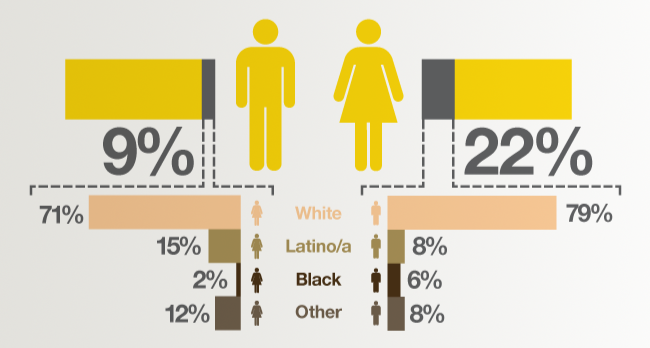
This mattered because it moved the documentary beyond one anecdotal couple. The data showed that such pairings were very common, and the complexities that Steven and Sandy faced could be a snapshot of what any similar couple might face.
From Taboo to Curriculum
Before 2013, there were few to no accessible, widely used teaching resources on the racial fetishization of Asian women. The film has since been adopted into university courses across ethnic studies, gender studies, sociology, and film studies programs. As of 2026, it is still being assigned. Academic attention to Asian American fetishization grew dramatically following the film’s release, from a handful of papers before 2013 to dozens of peer-reviewed publications, dissertations, and scholarly works by 2023. Our founder’s data journalism contributed indirectly to this educational infrastructure. Her transparent methodology modeled what rigorous public sociology looks like and how to evaluate its validity.
From Individual Harm to Structural Recognition
Before the Seeking Asian Female / They’re All So Beautiful launch, there were few to no laws or policies connecting racial fetishization to gender-based violence. By 2018, the Japanese American Citizens League published an explicit position connecting “yellow fever” to a violence pyramid. By March 16, 2021, a white American gunman had murdered eight people at Atlanta-area spas. Six were Asian women. When investigators and media initially refused to name racial fetishization as a motive, Asian American communities pushed back immediately, and rightfully so. With moral authority on their side, the community did not have to build the argument from scratch with the general public again. The vocabulary was already there. The frameworks were in circulation.
Research analyzing Twitter discourse following the Atlanta shootings found that 6% of 265,951 tweets explicitly discussed the intersection of race, gender, and sexualization, with ‘sexualization as racism’ emerging as a coherent public framework in a way it had not existed before 2013.
Of course, Seeking Asian Female / They’re All So Beautiful didn’t singlehandedly cause that shift. Filmmakers, artists, community organizers, and others had collectively been pushing forward for years, leading to policy conversations that made that legislation possible.
In 2021, following the Atlanta spa shootings, the COVID-19 Hate Crimes Act passed. It was the first federal legislation specifically responding to the surge in anti-Asian violence during the pandemic.
The Lasting Impact

By combining documentary storytelling, expert web series dialogue, and rigorous data journalism, Seeking Asian Female / They’re All So Beautiful provided at least three different entry points for audiences.
- The film provided emotional access.
- The web series added intellectual depth.
- Data journalism supplied the empirical grounding.
None of it worked alone. Together, they created something durable: a public understanding of racial fetishization as a serious, nameable, analyzable form of discrimination that crossed communities and registers.
This is what it looks like when art is paired with strategy, data, and an intersectional frame that widens the conversation enough for others to chime in with support.
We know art has the power to change the world, and we’re proud to have shown up for Seeking Asian Female / They’re All So Beautiful.
If we can imagine a better world, we can build it. Ready to think about what kind of impact your current work might have in 2034? Let’s talk.