

That’s a wrap! This week, Spain won the 2026 FIFA World Cup final in New York. For the first time ever, it included a halftime show. Produced by Global Citizen on behalf of FIFA, the show brought together:
- BTS,
- Coldplay,
- Burna Boy,
- Shakira,
- Madonna,
- Justin Bieber, and
- an elementary school chorus from Staten Island’s PS 22.
It was an 11-minute fundraiser. Yes, fundraiser. Trust us, more people saw and talked about it than your favorite nonprofit’s previous gala or Giving Tuesday campaign! Speaking of that, the show was built to grow the FIFA Global Citizen Education Fund. The plan is to raise $60 million, and they’ve already granted 58 community organizations in 20 countries, expanding access to quality education and soccer / football for roughly 400,000 children.
Pop culture can open doors to funding. But, what it can’t do is walk through those doors on its own. So, what can a $100 million for a halftime show actually buy? Millions to support students of all genders, including stuff like period products, safety, and credentials. You know, the things that actually keep girls in school, too.
We Were in the Room the Week Before It Happened
Before the final, we were at the EurAfrican Forum in Cascais, Portugal, hosted by the Portuguese Diaspora Council. It brings together investors, sitting presidents, ministers, philanthropists, and CEOs to discuss cross-border cooperation and human capital. During his opening speech, Global Citizen co-founder Michael Sheldrick described meeting an advocate who told him, only half-joking, she was her country’s “Minister of Menstruation.” She said millions of girls across the Global South and Global North drop out of school when they get their period because they don’t have access to affordable period products. Working together, their campaign generated something like 1,200 actions an hour, five million actions in total, until a government finally committed, publicly, to making period products a priority.
Sheldrick’s point wasn’t really about pads. It was about what “prosperity through cooperation,” the Forum’s theme, has to include if it’s going to actually deliver impact. That’s bigger than infrastructure and trade, and it can include Kendrick Lamar, Beyoncé, the World Cup and, yes, period products.
You can watch a clip of the speech, and read the transcript, here.
This Is the Work We Do
Whether they’re during a halftime show, a forum in Cascais, or a classroom in Kakuma, conversations about change are happening around the globe. But, talk is cheap. So, the question is: What happens after the moment of the moment passes and the attention ends? Every one of those moments generates attention. Yet, exactly none of them automatically generate a system that turns attention into sustained support.
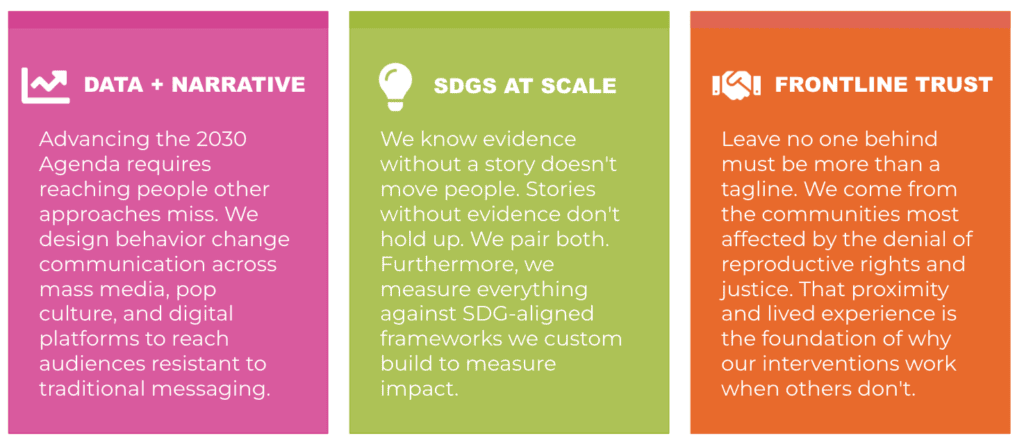
That’s the work we do with mission-driven organizations. We build the donor strategy, build integrated data infrastructures & social and behavior change communications strategies, and increase recurring-gift digital donations. We have a 20+ year track record that shows we can build viral moments AND turn them into sustained support that leads to impact.
That’s why we reached out to our friends at Brave Future and proposed a collaborative webinar, sharing recommendations with funders, practitioners, and others on what it actually takes to get girls from classrooms to sustainable futures. We kicked it off with a young Afghan woman, Nahid Salimi, sharing what it was like to walk that journey from a physical classroom in Afghanistan, to a virtual one, to a bachelor’s degree in software engineering in the UK.
Why We’re Built For This Moment
As our founder said during the event, “We want more Nahids.”
Brave Future brings access to classrooms and credentials for girls in Afghanistan and Kenya. We bring culturally appropriate maternal and reproductive health infrastructure. What’s more? We’re literally build for this moment.
Put all of this together, and you have a magical mix: not just girls in classrooms, but ones who stay there through graduation and continue on a path of their own choosing.
Let’s Talk
→ Are you a nonprofit leader? Talk to us about strengthening your fundraising.
→ Are you a Foundation program officer? Ask us about capacity-building for your grantees.
Want to see how we work first? Browse our case studies.
Watch video, and read full webinar transcript, below.
From Classrooms to Sustainable Futures
Webinar co-hosted by FUNKY BROWN CHICK, Inc. and Brave Future
📅 Date: Friday, July 17
⏰ 7:00 AM ET (New York)
⏰ 12:00 PM WEST (London, Tunis, Dublin, Lisbon, Lagos)
⏰ 1:00 PM CEST (Geneva, Paris, Brussels, The Hague)
📍 Livestreamed / Online
Closed captions and transcript (both provided for increased accessibility for Deaf and hard-of-hearing viewers, non-English speakers using auto-translate, and anyone who prefers reading) may include errors due to auto-transcription.
[0:03] Karla: Good afternoon, everyone, and thanks for joining us for this important discussion titled “From Classrooms to Sustainable Futures,” brought to you by Brave Future and FUNKY BROWN CHICK, Inc. Wherever you’re joining us from today, you are most welcome. My name is Karla Mcdermott. I am the Director of Development and Outreach at Brave Future, and I’ll be moderating today’s conversation. So today, you’re going to hear from three different perspectives on what it takes to get from classrooms to sustainable futures. You’re going to hear from a young woman who’s living it, an organization working at the health and rights barrier, and an organization working at the access and credentialing barrier. We’ll be keeping strong housekeeping, keeping it tight to forty-five minutes, so that we can get to all three voices. So let’s get started. First up is Nahid, a student who will be sharing her personal journey in education. Good afternoon, Nahid. How are you?
[1:11] Nahid: Good afternoon, Karla. I’m good, thank you.
[1:14] Karla: So pleased to have you here with us today. We are looking forward to hearing your side of this important topic, so please tell me, where was your classroom, and what was it like?
[1:28] Nahid: When we talk about classroom, I actually have experience being part of different classrooms. Before [the Afghan government closed girls’ schools], I was a student in physical classrooms, but after the government closed the schools, I found Brave Future, and Brave Future offered a virtual hub, or virtual classrooms, for me. So that’s how I continued my education and earned an internationally recognized diploma through Brave Future’s virtual classrooms.
[1:58] Karla: Amazing, amazing! When you finished that, then what did you do?
[2:05] Nahid: It took me two years actually, it was not two months, it took me two years — to be in these amazing Brave Future classrooms. And after I finished that, it gave me a high school diploma that allowed me to get a bachelor’s degree in software engineering at a UK university, and right now I’m pursuing my bachelor’s degree there.
[2:28] Karla: That’s amazing, I love that. How was that transition from a physical classroom to online? Was it difficult, or were you able to take to it quite easily?
[2:40] Nahid: To be honest, I would say I never expected myself to finish my high school through a virtual classroom — that was not my expectation at all. But when I had to, and when I joined, it was a fabulous experience. It was as learning-centric, as supportive, as lovely a community as you can expect in an excellent school, which I had in my career at Brave Future. So while it was a completely brand new experience for me, it was a great experience. I loved it, and I’m so happy that I managed to finish it.
[3:15] Karla: Awesome! And now that you’ve finished university, what would you like to do after you graduate?
[3:25] Nahid: I have exciting plans ahead of me. I will graduate this September, and after that, I already know which area I’m most interested in, which is ethical AI and how AI can shape the economy of a country. So first, I will try to get more internship and professional experience, and later, in September 2028, I will pursue a master’s degree in ethical AI and how AI can shape the economy of a country.
[3:56] Karla: Amazing! Such big aspirations. It’s so amazing to see that you are taking serious steps along that journey. Thank you for sharing with us today. We’re going to move on now. Our next voice is Twanna Hines. Twanna is the CEO and Founder of FUNKY BROWN CHICK, Inc. — an organization working at the intersection of culturally appropriate maternal and reproductive health programming. Twanna, how are you today?
[4:27] Twanna: I’m doing great, girl. How are you?
[4:30] Karla: I’m good. You look fabulous in that bright yellow.
[4:34] Twanna: Thank you! Yellow is one of my favorite colors. The lighting here makes it look like I’m literally illuminated, which is kind of fun, but yeah, thank you for having me. Very happy to be here, and I love Nahid’s story. We want more Nahids. Right? We want more girls having access to education and building their own futures. So excited to see that. So, a bit more about us? Who are we?
[4:59] Karla: Tell us about your work.
[5:03] Twanna: Yeah, happy to tell you a bit more about our work. FUNKY BROWN CHICK is a social impact firm. The easiest way to say it is that we help organizations do more. An organization is already existing, doing great work, and we just help them do a bit more, and help them scale. We’ve been in business about twenty years — twenty-one, to be exact — and we’ve worked with over 100 nonprofits, NGOs, and small businesses, helping them grow in one of three ways:
- more money: so increasing and scaling the funds coming to their organization;
- more people: participating in whatever programming or policy solutions they’re advancing;
- and sometimes more awareness.
I know for some of you tuning in right now, this may be the first time you’ve heard of Brave Future, or maybe even the first time you’ve heard of FUNKY BROWN CHICK. So we’re very excited about making sure important causes get more awareness. To give a little concrete context for each of those, we’ve got Q&A at the end. So, for more money: it’s important that we talk about that because funding is collapsing for women’s and girls’ programming, including education, right now. We’re hearing that from across all of our clients and partners. When we talk about more funding, an example of how this has worked with one of our clients — a nonprofit newsroom and human rights organization focused on investigative journalism — we were able to bring them 100,000 more supporters, increase the amount of money they got from fundraising by 20%, and get them a four-times return by going digital-first with fundraising. That was one of the ways we helped that organization get more, and we want to help more girls’-education organizations do exactly the same thing. Then, more people — sometimes the problem isn’t just that an organization needs more money, it’s that they need more people in the programs that already exist. An example: an organization founded by formerly incarcerated people. We worked with them because they had access to free healthcare counseling and wanted to make sure as many people as possible got connected to those services during reentry. Fantastic cause — we wanted to make sure as many people as possible could access it, and we worked with them to directly connect 1,700 formerly incarcerated people to healthcare services. That’s the kind of thing that’s important to us. And the last of the three buckets is awareness — a lot of our work is helping organizations get greater awareness, to a greater number of people, of what’s actually going on. As a digital-first org, we always start there. Even if we get you in the New York Times, which we’ve done for clients — that’s a great experience, and people do still read the physical New York Times with their coffee — but most people are going to see it here, on their phone when they wake up scrolling, or trending on Bluesky or X. So we do a lot of work getting people that information. Those are the three ways we help people do more, and we’re incredibly interested in working with people who’ve been traditionally left behind — women, girls, LGBTQ communities, people connected to informal economies — anything we can do to make sure “more” includes the people attached to it as well.
[8:56] Karla: Awesome, thank you so much — you guys have done a lot, and you’re doing a great job. We’ve heard from Nahid about what her classroom looked like and her aspirations, and we just heard from Twanna about everything FUNKY BROWN CHICK is doing to help organizations do more. Let’s now turn to Marcela Nacif. Marcela is the Founder of Brave Future, a nonprofit designing and delivering quality education across various contexts — from Kakuma refugee camp in Kenya to virtual delivery models in Afghanistan. Welcome, Marcela. How are you?
[9:37] Marcela: Thank you so much, Karla. I’m very well, thank you so much for having me here today.
[9:43] Karla: Amazing! Our theme today is from classroom to sustainable futures. What do you do when there is no classroom?
[9:55] Marcela: That’s a question with a lot of different angles. I think here “classroom” really represents the vehicle that delivers the education — the pathways, the teachers, and the quality that everything should have. So I can give you examples from the two main contexts we work in: Afghanistan and Kakuma. When you take away that vehicle — where you don’t have classrooms — we need to start understanding what the barriers are to delivering education. Let’s take Afghanistan as an example. The main barrier is political: you have the government prohibiting girls’ education after sixth grade. So you have cases like Nahid’s — it’s really important to understand, okay, now you cannot go to school because the government is putting up a barrier. So how can school look like, and how does a classroom look like? The first thing we did was turn to online education, giving them access to it. To do that you need to provide computers and internet access, and by having that access you give them access to the world — through this, we’re able to connect them with different mentors and teachers around the world, and they’re able to pursue education in an alternative way. But combined with this government prohibition, you also have a lack of recognition — because if the government doesn’t recognize your pathway, since it’s prohibited, you need to find a different way to make that learning pathway accredited. The way we did that at Brave Future was to find a curriculum that is internationally recognized — in our case, the British curriculum — so that when the girls finish their pathway, they finish with a credential they can hold onto. No one can take it away from them, and they can use it to apply to universities or pursue whatever pathway they decide. That’s really important for sustainability, and Nahid’s story really illustrates that, because she finished her pathway with credentials. Credentials are recognized anywhere — she came to Portugal, and now she’s pursuing her bachelor’s in software engineering. So that’s a beautiful example of classroom to sustainable futures. On the other side, in Kakuma refugee camp in Kenya, you don’t have government prohibition, but you have a lack of education infrastructure in general. You have good primary enrollment, but less than a quarter of refugees actually access secondary education, and of the refugees who access secondary education, less than 3% actually pass the Kenyan national exams. So there’s a massive gap in quality and infrastructure — lack of teachers, overcrowded classrooms. We need to understand what those barriers are and build the system around them. In our case, the way we managed to overcome this was by building a digital learning hub equipped with solar panels, computers, and internet access, connecting students who were previously in classrooms with 100-plus kids to international teachers, and building personalized learning pathways — first covering the gaps from primary schooling, then giving them high-quality secondary education that’s recognized anywhere and lets them pursue further education or integrate into the job market. So overall, I’d say the biggest thing is really understanding what the barriers are and finding a way to build a bridge — not just a bridge for the challenges, but a bridge that leads somewhere. We need to understand the barriers to the next step, and build from there. Hope that answers the question.
[14:41] Karla: Yeah, amazing, thank you so much, Marcela — I agree completely, and I love working with you every day. One of the things I always share when people ask who we are at Brave Future is that we deliver adaptable and flexible education to various communities, because that’s the most important thing — and the second most important thing is that our students earn a recognized diploma to carry with them wherever they go, so they know their time was qualified — they can hold it up and say, “this is where I’ve been, this is what I’ve been doing.” Thank you, Marcela. I want to share a quote I found the other day: “122 million girls are still out of school today, not because they don’t want to learn, but because the systems around them have failed them” — and I think that’s what we’re talking about today. 122 million girls. Now, we [Brave Future] provide education for everyone, but this discussion is focused specifically on girls, and that’s why we’re having this conversation. Just to take a deep dive for a minute — we’ve heard three different perspectives on how we go from classrooms to sustainable futures. I want to open it up a bit more between our three panelists. So I’m going to go back to Nahid. Lovely Nahid, I want to ask: how is professional life different from student life?
[16:15] Nahid: That’s a very good question, Karla. Just as it was a brand new experience for me to move from physical to online classrooms, it was a complete transition to enter the world of professionalism, which I entered through an internship. I’d say there are differences and similarities between student life and professional life. The biggest difference is that as a student, the mistakes we make are usually written in pencil — we can usually erase or correct them easily. In the professional world, we work with pens, so it’s harder to erase or leave without a trace. We have to act more cautiously and be more serious. On the other hand, the similarities are that we still have a lot to learn — there’s always room for improvement, and the fact that life is continuous learning and continuous development is what I learned in my internship as a professional experience: continuous learning and continuous growth.
[17:29] Karla: Amazing, that’s awesome! So you’re not only completing your bachelor’s degree, but also working and participating in an internship — is that correct?
[17:42] Nahid: That’s exactly correct. I’m doing my bachelor’s degree, I’m working to sustain my life, and I’m getting practical experience through an internship in an area I’m really excited about, which is AI. And as I said earlier, later on I want to learn more about how we can change the economy of a country using AI. So it’s an absolute pleasure to do this internship — it’s a fabulous experience.
[18:13] Karla: And it’s our absolute pleasure to watch you along this journey — it’s been amazing watching you go from target to target, tackling each step with determination and grace. I want to move on now to Twanna. Twanna, if a funder came to you tomorrow and could only fund one line item — health or education — what would you tell them? What would you tell them they’re getting wrong about that choice?
[18:46] Twanna: Well, it’s kind of a false choice, right? Because those aren’t two different line items — it’s one line item. It would be like asking Nahid, “Are you a student or are you a girl?” Some students are girls, and some girls are students — you can’t pull those apart, and it’s the same with health and education. I don’t care how much you fund a school — if the girls or any of the students are sick, or they can’t get to school due to transportation, or you haven’t put in culturally appropriate maternal or child health education or access to period products and things like that — all of that affects the odds of getting a student out the other end. As Marcela was saying, it’s not just about graduating, but what comes next — enrolling, graduating, and going on. You really cut the opportunity for that if you separate them. So for a funder thinking they’ll only fund one or the other, you really have to see them as one. And if you cut funding in any area — like we’re seeing with women’s and girls’ programs right now — UN Women actually released a report recently that said 84% of organizations saw an increase in need due to conflict and other reasons, and 88% of them had their funding cut in some way. So if a funder came and asked, “should we fund health or education right now?” I’d say you can’t separate them — you really can’t.
[20:27] Karla: That’s true. I think we’re still going to be seeing the ramifications of the aid cuts in the coming months, and definitely in the coming years. Thank you, Twanna. Marcela, you’re up next — what are two important lessons you’ve learned from your work at Brave Future?
[20:51] Marcela: Only two? [laughs] Okay, two. I’d say, first, the importance of putting the student — the learner — at the center. Especially in humanitarian work, there are so many interests in play: funders, governments, ourselves — so many interests that we can forget about the child, the student, the learner, the girl. It’s really important to understand them first, and their challenges individually, and create a system that fits them rather than forcing them to fit a specific system. Standardization can be a huge challenge for the success of a program — sometimes we assume something that worked for other students will work the same for everyone, and it doesn’t. So, always take a step back and understand the students first. Second: education only becomes a future if we’re able to convert it into something. I could spend the rest of my life teaching programming classes in Kakuma, which is nice, but if that can’t translate into a job or university or the next step, something’s missing. We need to take the time to build that pathway and focus education initiatives not just on the program itself, but on what comes next. For example, with Nahid — if we had just given her a course to complete, she wouldn’t have been able to build her sustainable future, because her qualifications needed to connect to something. In her case, that was university and the job market — it’s important to keep that in mind when designing programs.
[23:10] Karla: Very good — exactly, adaptability and flexibility, and then that piece of “you have that, now what?” What are the next steps? Our model is evolving as we come to grips with this too — in cases where higher education isn’t possible, what’s next for these students? Vocational training? Internships and mentoring, preparing them for the next challenges? You’re exactly right. Moving on now to what we came here to actually produce, which is the recommendations. I want to go back to Nahid, since she’s living this model and has valuable feedback. Nahid, you spoke eloquently about the hardest part of going from student to professional being like moving from a pencil to a pen. For Afghan girls coming behind you, what do you think we should be considering? Maybe something you wish you’d had as support.
[24:25] Nahid: Whatever I say, there will still be so many more things for them to experience once they actually do the internship. But if I give one example — let’s communicate a bit more effectively, because it’s a completely new environment. The people we work with, engage with daily, aren’t our college peers — they’re our mentors, our managers. So we should communicate with them more professionally, because it has a lot of influence on what we do next. That said, I can’t emphasize enough how much I loved doing this professional internship — it was a fabulous experience. I learned so much throughout the internship. I made a lot of mistakes, but these were things I learned from — it was a fabulous journey, and I hope we can provide these kinds of opportunities for other Afghan women, because it’s a great learning opportunity.
[25:42] Karla: Amazing, yes — I like how you framed that. Everything we call a “mistake” is really a lesson — something we’ll either do again in the future, or something we won’t. Everything is a lesson if we take it that way. Thank you, Nahid. Twanna — you were talking about how education and health aren’t two different things, and that to support women and girls toward sustainable futures, funders must support both. If you had the ear of funders today, what would you ask them to do or consider?
[26:26] Twanna: I love this question. I’m going to assume we do have the ear of funders — I saw some of you RSVP to this, so that’s exciting, we do have funders watching live, and some will probably watch the recording too. I’d just say: honestly, remember that women and girls are people. It might sound weird to say that, but when we talk about funders shifting what they’re funding, or funding streams moving away from certain areas, we can’t divorce the fact that women and girls are people. Whether we’re talking about human capital, banking, education, infrastructure, anything — women and girls are at least half the population. If you’re not impacting them, it’s going to show up downstream. The reason there’s funding for youth, for women, for girls, is that there are very real, concrete, structural barriers that make it harder for those communities to access what other communities can access. When you take funding away from that, the problem doesn’t go away — it gets worse, because the deepest problems tend to show up in those communities first. So that’s what I’d ask funders to really consider: women and girls are people, and if you’re investing in human capital, in the arts, in humanities, in anything that affects people — that affects women and girls too. That’s just true.
[28:27] Karla: Thank you, Twanna, spot on. Marcela — you mentioned two valuable lessons. What do you need to ensure Brave Future is able to continue offering access to quality education for conflict-impacted communities?
[28:50] Marcela: Thank you, Karla — good question, and I think it’s a challenge everyone working with NGOs is probably facing right now, which is essentially funding, and understanding that education is a process — it takes a while. Nahid was with us for three or four years until we concluded her education, and then she came to Portugal and found a job. It’s a long process, but funding cycles are usually very short, and tied to how many kids you can impact — it’s a lot about numbers. It’s really hard to focus both on impacting a lot of numbers and ensuring the whole pathway is sustainable through to the end. It’s great to impact numbers, but it would also be important to fund full cohorts — start funding cohorts from the beginning to the end, which means multi-year funding cycles, and be able to prove results not just by the number of learners enrolled, but by the outcomes of learners when they leave the program. That would be a huge barrier to overcome in terms of funding.
[30:18] Karla: Thank you, Marcela. I want to open the chat up between the panelists, but first — for those tuning in live, please feel free to add questions or feedback in the comments, and we’ll try to get to them. I was just thinking, Marcela, about what you said — everybody looks at the numbers when going through grant applications, and sometimes we can feel like a tiny organization doing impactful work that big funding engines won’t see, because we serve this many students instead of that many. It’s that paradox of quality versus quantity — we’re not addressing large numbers, but the numbers we are addressing, we’re making a real difference for. That’s the idea behind what we like to say to our learners: “once a Brave Future learner, always a Brave Future learner.” You start with us, and whether or not you finish the academic side, we stay engaged with you — through workshops, mentorship, and guidance — all of that is still valuable. So I’m going to open it up now between Nahid, Twanna, and Marcela. Do you have questions for each other before we get to the audience questions in the comments?
[32:07] Nahid: Actually, I have a question for Marcela.
[32:12] Karla: Go ahead.
[32:12] Nahid: As you mentioned, Karla, once a Brave Future student, always a Brave Future student — and that’s exactly what we’re doing here with Marcela. I was with Marcela when I was doing high school, and then when I entered university, I was with Marcela, and when I joined the work environment, I was with Marcela — I’m like her first learner. I want to ask Marcela: how was her experience being in a completely new environment, working with Afghan women? I believe she also had no prior experience working with Afghan girls and helping them get an education — how different was it, and what did she really enjoy about it? I know you enjoy it, because you keep doing it with so much love and passion — so tell us something about it.
[33:05] Marcela: I think it’s absolutely rewarding, and at the same time — how can I say — it’s not that different from working with students elsewhere in the world. You girls are still absolutely ambitious — one thing I’d say is very determined, sometimes a little stubborn, very high-achieving. So I did have to step back and understand: okay, how do I channel this drive and energy toward a single goal? But it’s been absolutely rewarding — you know how much I love you girls, and it’s really the best part of my life to work with you and see you achieve your dreams. All the ups and downs we’ve gone through together — university applications, visas, moving to a new country — I’ve felt every step with you, and we’ve celebrated all the little steps together. You give a lot of meaning and purpose to my life, and I’m absolutely grateful for that. I also think, especially focusing on girls in Afghanistan — there are so many problems around the world, and they’re very structural, and so hard. But when you look at the girls, and there are so many problems in Afghanistan, the barrier being strictly a prohibition based on gender is outrageous — it’s outrageous that we live in a world like that. So I still hold up the fight, as a woman, as your teacher, and as your friend, to make sure you know you’re not forgotten, you’re not alone, and we’ll get through this one step at a time, together.
[35:21] Karla: Thank you — great question, Nahid, great answer, Marcela. I had a quick question for Twanna. I know a lot of your work in the past was in the U.S., and you’re a much more global organization now, with a focus that includes Europe. Do you find a difference in that, or is it a different breadth of issues you’re encountering? You’re still on mute, Twanna.
[36:04] Twanna: At my firm, we call that “pulling a Twanna” — when someone talks while they’re still on mute. Whether it’s Zoom, Teams, a livestream, doesn’t matter — I’ll do it every time, so please flag it if I do that again. But I love this question, because it’s layered in so many ways. One — I’m sitting here in Lisbon right now, and I know we’re all over the world watching. One of the things I notice, regardless of topic — since we’re talking about girls’ education, let’s talk about sexual and reproductive health and rights — even within one discipline, the way it looks, the way it’s funded, and even the language used, changes quite drastically. There’s a difference between reproductive health, reproductive rights, reproductive justice, and sexual reproductive health and rights, and all of that is different again from HIV/AIDS funding, which is different from maternal and child health funding. So from a programmatic and a funding-stream perspective, the way these things are configured — that’s just talking about the United States. If you broaden it out, you’re also talking about family planning and global health. I think we need to do more, as practitioners — and we do this with our clients — to help them think about what’s the actual problem we’re trying to solve, not the discipline, not the language. That’s what unites global work with U.S. work. In the U.S., we tend to talk about “domestic” versus “international,” whereas in the EU and other countries, there’s much more of a sense that there’s what’s in my country, what’s in our region, and what’s in the world — it’s not seen as two completely separate buckets. What happens in Russia, in Gaza, in the United States, in Afghanistan, in Kenya — these things are all interconnected. So I love this question about how we think through the differences between working in global contexts. And, to brag on ourselves for a moment, one reason I think we’re successful is that our focus is on the people left behind — so we’re really careful to figure out what this particular community actually needs, which gives you a tailored, effective approach for that community, and we apply that regardless of which program we’re working on. For Brave Future, what’s needed for maternal health is going to look very different in Afghanistan than in Kenya — even the understanding of what it means for an outsider to talk about your health and reproduction is going to be very different across those two cultural contexts.
[39:16] Karla: Yeah — you know, I thought of this because I had such an enlightening conversation with you a few weeks ago about what family planning looks like across different contexts. I shared something we’ve seen firsthand in Kakuma refugee camp in Kenya around the idea of family planning and awareness. Sometimes funding is given for something specific — contraception — and organizations distribute a bunch of contraceptive pills expecting people to just take them because they’re told to, without any education or awareness. So there isn’t take-up, because people have the misconception that they’re being used as test cases, or that the pills are making them feel bad — nausea, bloating — when actually a lot of people experience those same symptoms on contraceptive pills. But instead of that knowledge being shared with the community, people just stop taking them because they think something bad is happening. So there’s a whole awareness piece that comes with the funding and support you provide — not just getting resources to people, but spreading that complete awareness. Thank you so much — I love talking to you, because you’re such an expert on this and provide so much insight into how to better serve our beneficiaries. Let’s look at the questions in the chat — “the children of Eastern DRC also need your support.” Can I direct this to Marcela, to speak a little about that? That’s from the community.
[41:21] Marcela: Yes, absolutely — it would be amazing to be able to expand our programs to the DRC and other parts of Kenya. It’s our biggest desire to grow and expand and make sure every child in the world has access to high-quality education. I won’t promise we’ll go soon, but I promise we’re working really hard — improving ourselves, gathering evidence from our model, making it scalable and cost-effective, and building something that works for students around the world. We hope we’re able to expand to the DRC and other places soon.
[42:23] Karla: Yeah — and that’s the reality of what we’re doing. We get contacted by educators and other nonprofit organizations all over the world, asking if we can come in and support. We’ve had those conversations, but unfortunately, at this time, Brave Future is capacity-constrained, and we can’t expand our delivery beyond our current programs without sacrificing the quality we provide. That’s where funders come in. Thank you for that question, whoever asked it. Before we close, any last thoughts from our panelists?
[43:07] Twanna: Karla — this is Twanna here, not on mute for once! I’d like to add something to what you said earlier, when you talked about Brave Future sometimes feeling like a small group looking at the number of people you’re reaching. I’d argue you’re not building the case that you’re reaching every girl everywhere in the world — you’re building the case that you have a replicable model that can be tailored and applied elsewhere. As funders think about this — and we should be sympathetic to funders too, since they also face greater need due to funding cuts from different governments, more and more organizations asking for a pot of dollars that isn’t growing at the same rate as the need — I’d call on funders to have actual conversations with organizations before even getting to the applications. Ask them: what are the kinds of things you feel your project would be most replicable in, in other situations? Who’s contacting you right now asking if you can do what you do in a different community or area? So I think the size of the organization isn’t always where the focus should be — it’s the effectiveness of the model. Models can scale, models can grow, if they’re effective. That’s what we do at [FUNKY BROWN CHICK] anyway. I think that’s important.
[44:44] Karla: Thank you — you always bring it together so nicely, thank you all. We’re coming up on forty-five minutes, and we’ve done so well — big thanks to all of you. So, just as a recap: today we discussed going from classrooms to sustainable futures, and the idea that girls’ health and girls’ education are not two separate things. We’re here for anyone who has questions. Thank you to our speakers for your time and for making your case so clearly, and thank you to everyone who tuned in. This session was recorded and we’ll be sharing it — please pass it along to anyone in your network who could benefit from hearing this. If you’d like to follow up directly with Brave Future, FUNKY BROWN CHICK, or any of our panelists, please reach out — we’d welcome the conversation. Thank you again for joining us today for “From Classrooms to Sustainable Futures.” Thanks, guys — look forward to next time.